At Hydroponic Systems, we have been working for years with strawberry growers around the world who are looking to improve the yield of their greenhouse crops. One of the most frequently asked questions we receive is how to determine the ideal crop density: how many plants should be placed per square metre to obtain maximum production without compromising fruit quality or root health.
There is often a belief that more crop rows equal higher production, when in fact the opposite is true. Excessive density causes competition between plants, reduces aeration, increases relative humidity and promotes the development of root diseases. On the contrary, a well-designed structure—combining appropriate gutters and spacers—optimises space, improves drainage and promotes root development.
In this article, we will explain
- How to correctly determine the density of strawberry cultivation in greenhouses.
- What technical factors you should take into account.
- How a well-structured system can help you achieve a perfect balance between number of plants, yield, and sustainability.
The importance of density in crop yield
Crop density is one of the most decisive factors for the productive success of a strawberry greenhouse. Incorrect density can significantly reduce yield, even if nutritional and climatic management is correct. In our experience, achieving the ideal density involves finding the balance between the number of plants and the physical conditions of the environment: light, ventilation, drainage and available substrate volume.
When the space between rows or between plants is insufficient, competition for essential resources intensifies. The most exposed plants grow vigorously, while the inner ones receive less radiation and ventilation, resulting in less flowering, smaller fruits and a higher incidence of disease.
On the contrary, a well-calculated density allows for better use of productive space, maintains a more stable microclimate, and produces uniform, high-quality fruit.
Why more rows do not mean more production
When designing a new greenhouse or renovating a facility, growers often tend to think that adding more rows is the most direct way to increase production. However, the data shows the opposite: excessive density reduces yield per plant and, consequently, the total production of the system.
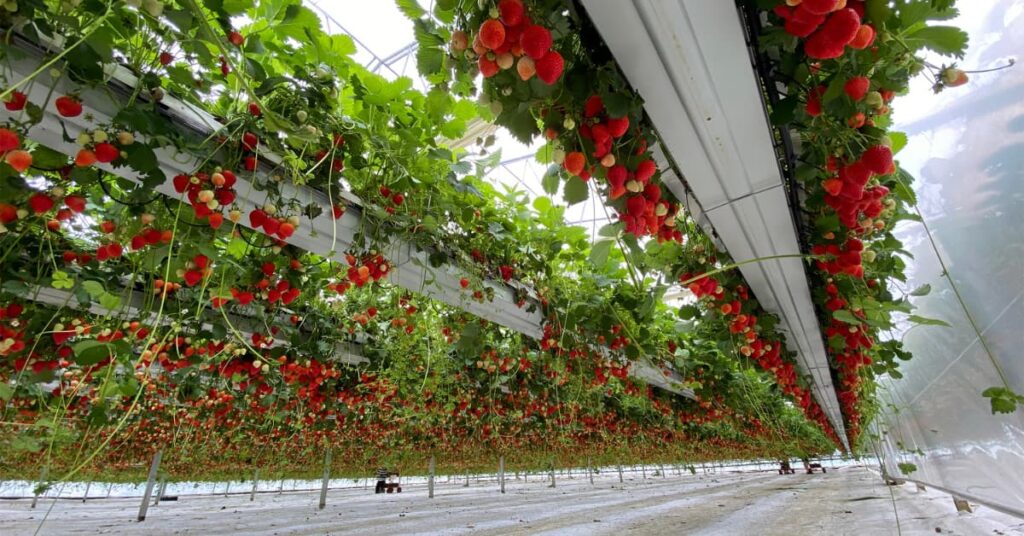
A clear example can be found in one of our projects, where a farmer went from working with 12 lines (from the competition) to only 8 lines with our gutter and Spacer system. The result was overwhelming: yield increased from 0.6 kg per plant to 1.5 kg, proving that fewer lines can generate more production if the system design is correctly dimensioned.
Success lies in giving each plant the space it needs to develop fully, with good ventilation, uniform drainage and sufficient light.
How system design influences productivity
The structural design of the growing system directly influences yield. At Hydroponic Systems, we focus on creating solutions that optimise the relationship between density and productivity, using gutters and spacers that maintain a constant height, effective drainage and adequate aeration under the grow bags.
When drainage flows correctly and there is no water accumulation, the roots remain oxygenated and active, resulting in more vigorous growth and more uniform production. In addition, the proper layout and spacing of the lines facilitates maintenance, harvesting and sanitary control, improving the overall efficiency of the system.
In short, density is not measured solely in terms of the number of plants per square metre, but in how the system design allows each plant to express its maximum productive potential.
Key factors in determining crop density
At Hydroponic Systems, we know that correctly determining strawberry crop density is not just a matter of counting the number of plants per square metre. It is a balance between physical, biological and structural variables that directly influence growth, flowering and final yield. The three most decisive factors are lighting, ventilation, root oxygenation and drainage.
Lighting and ventilation inside the greenhouse
Light is the driving force behind cultivation, and its distribution inside the greenhouse determines plant development and fruit quality. Excessive density reduces solar radiation penetration, causing shading, lower photosynthesis and fruit with lower sugar content.
Similarly, ventilation plays an essential role: insufficient air flow increases relative humidity and promotes the development of fungi and root diseases.
Therefore, when defining the distance between rows and between gutters, we must ensure that light reaches all levels of the crop and that there is constant air movement to maintain a balanced microclimate.
Root oxygenation and drainage management
A healthy root system needs oxygen to maintain its metabolic activity. In hydroponic or soilless systems, oxygenation depends directly on drainage and the substrate’s ability to remove excess water.
If the system design causes accumulation or slow drainage, the available oxygen decreases and the roots begin to suffer stress, opening the door to pathogens such as Pythium or Phytophthora.
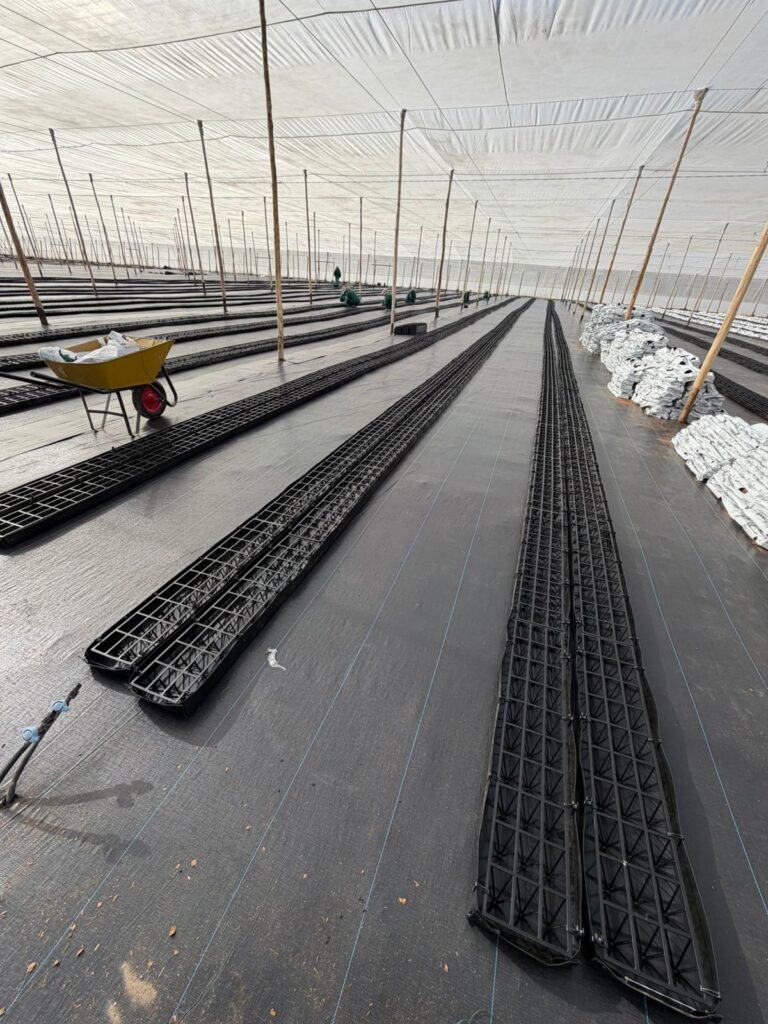
Our spacer gutter systems are designed precisely to avoid these problems: they raise the grow bags and facilitate drainage circulation beneath them, maintaining an oxygenated and stable root environment. This difference, although seemingly minimal, marks a qualitative leap in crop productivity and uniformity.
Plant spacing and use of usable area
Plant spacing not only defines how many rows fit in a greenhouse, but also how radiation, air and humidity are distributed.
In our experience, optimal spacing allows you to:
- Maximise light capture without creating shade between plants.
- Facilitate ventilation and reduce humidity in the leaf area.
- Ensure easy access for harvesting and maintenance.
- Maintain sufficient substrate volume for healthy root development.
Correctly sizing the density means making the most of the productive area without compromising the physiological balance of the plants. This is where the design of the system — gutters, height, slope and use of spacers — determines the overall efficiency of the crop.
Real-life cases: how to optimise density with gutters and spacers
At Hydroponic Systems, we work alongside producers who seek to maximise their productivity without compromising crop health. Over the years, we have found that success does not depend on how many lines we install, but rather on how we design and manage them. Choosing the right system—gutters with the correct slope and height and the use of spacers—has a direct impact on the ideal density and efficiency of each square metre cultivated.
Success story: from 12 lines to 8 lines, doubling production
One of the most illustrative examples comes from a producer who was working with 12 lines of a conventional system. At first glance, it seemed like an efficient design, but the excessive density caused competition for sunlight.
After redesigning the system with 8 lines equipped with gutters and spacers from Hydroponic Systems, production per plant was doubled: yield increased from 0.6 kg per plant to 1.5 kg per plant.
This improvement was mainly due to the plants receiving more light, uniform drainage, and the roots remaining oxygenated throughout the cycle. In other words, lower, well-dimensioned density resulted in higher productivity and better fruit quality.
Advantages of the Spacer gutter system compared to conventional methods
Unlike traditional cultivation systems using raised beds or flat gutters, the Spacer gutter system offers technical advantages that directly influence crop health and productivity:
- It prevents the substrate from coming into contact with accumulated drainage, reducing the risk of root diseases.
- It improves aeration and oxygenation at the base of the plant, promoting root development.
- It standardises drainage, preventing saturated or dry areas.
- It optimises the height and slope of the gutter, ensuring a constant flow of water.
- It facilitates maintenance and cleaning between crop cycles.
These characteristics not only prevent root problems, but also improve the use of light and space, which translates into higher yields per plant and per square metre.
Which Spacer model to choose according to the type of crop
Each type of Spacer is designed to adapt to the growing conditions and the type of greenhouse structure. The right choice influences the stability of the system, ease of handling and drainage efficiency.
- Spacer Premium: recommended for high-density soil crops, offering stability and ideal separation between the grow bag and the gutter. Perfect for vegetables. It can also be integrated into an elevated metal gutter in the shape of an inverted U (Premium Elevated System) for growing strawberries.
- Hydropot Spacer: perfect for potted berry crops, such as blueberries, with continuous flow drainage systems, ensuring constant aeration.
- Elevated Spacer: designed for elevated systems, optimising ergonomics and drainage in taller structures. Due to its shape, this Spacer integrated into the Evolution system is ideal for strawberry cultivation.
With this range, growers can adapt the system to their infrastructure and define an optimal density that maximises yield without affecting root health.
Practical recommendations for calculating ideal density
At Hydroponic Systems, we understand that every strawberry growing project is unique. Climate conditions, greenhouse type and crop variety directly influence optimal density. There is no universal formula, but there is a technical methodology that allows you to correctly size the system and maximise yield without compromising crop health.
Technical factors: type of gutter, height and drainage flow
The choice of gutter type is the starting point. Its shape, slope and depth determine the drainage behaviour and stability of the root system..
- Gutters with a controlled slope allow drainage to be evacuated evenly, preventing accumulations that limit root oxygenation.
- The installation height influences both work ergonomics and root zone ventilation. An adequate height promotes air flow and temperature at the base of the crop.
The use of spacers helps maintain this stability, as they raise the grow bags and prevent contact with residual water, preserving an active and healthy root environment.
Common mistakes when oversizing crops
One of the most frequent mistakes is oversizing density, seeking to increase the total production of the greenhouse without considering the physiological consequences.
The most common mistakes we see are:
- Reducing the space between rows too much, which decreases the light available to the inner leaves.
- Installing more plants than the system can drain, causing moisture accumulation and root asphyxia.
- Failing to adjust ventilation and irrigation to the new configuration, creating humid microclimates that favour the growth of bacterias.
In these cases, total production may even fall below that obtained with a lower density. That is why we insist that more plants do not mean more kilos of fruit, but rather greater risk if the system is not correctly sized.
How to adjust density based on climate and strawberry variety
Each strawberry variety behaves differently depending on the environment. Those with more vigorous growth, such as “Monterey” or “San Andreas”, require greater spacing than other more compact varieties.
In addition, climatic conditions directly influence the ideal density:
- In hot and humid climates, it is recommended to reduce density to improve ventilation.
- In cold areas or areas with low radiation, density can be increased slightly to make better use of productive space.
In all cases, the goal should be to maintain a balance between density, ventilation, drainage, and access to light. We work with growers to define that balance through technical testing and simulations prior to installation.
Benefits of balanced density in hydroponic greenhouses
At Hydroponic Systems, we have found that balanced crop density not only optimises production, but also transforms greenhouse management. Proper plant distribution improves the efficiency of the entire system: from light capture and aeration to root health and nutrient utilisation.
Higher yield per plant and better fruit quality
A balanced density allows each plant to receive the right amount of light and space to develop its maximum productive potential. By reducing competition between plants, more uniform flowering and better fruit distribution are stimulated.
The results we have observed in the field are clear: when plants grow without stress from overcrowding, the fruit is larger and firmer. Furthermore, the increase in yield does not come from the number of plants, but from the increase in individual production, which significantly improves the profitability of the system.
Reduction of root diseases and competition stress
Excessive density increases moisture in the root zone and reduces air circulation, creating the ideal environment for pathogens. By correctly sizing the density, we are able to reduce the pressure of root diseases and maintain a stable physiological balance.
The use of spacer gutters is key in this regard: by keeping the bags elevated, contact with accumulated drainage is avoided and root oxygenation is improved. In this way, the system becomes more resistant to changes in humidity and temperature, reducing water stress and the onset of disease.
In short, a well-structured design strengthens the roots and prolongs the productive life of the plants.
Greater efficiency in water, light and nutrients
In hydroponics, efficiency is as important as production. A balanced density helps ensure that every drop of water and every unit of fertiliser is used effectively. By reducing competition between plants, nutrients are better distributed and roots can absorb them more regularly.
Similarly, proper spacing between rows allows light to penetrate evenly, improving photosynthesis and reducing energy waste. This balance translates into lower operating costs and greater system sustainability.
At Hydroponic Systems, we work precisely with this goal in mind: that the technology we apply—gutters, spacers, and technical design—helps growers achieve higher production with fewer resources.
How we can help you optimise your crop density
At Hydroponic Systems, we understand that every horticultural project is different. That’s why our work isn’t limited to supplying components, but also includes designing complete, efficient systems tailored to each grower’s conditions. The ideal crop density isn’t a fixed number, but the result of a well-balanced technical design.
Our technical approach to gutter and spacer design
Our approach is based on a simple principle: the structure of the system determines productivity. The gutters and spacers we develop are designed to maximise drainage flow, maintain root oxygenation and make the most of the available space.
Each model responds to specific needs:
- HS Evolution and HS Premium Elevated gutters: designed to ensure constant drainage in metal gutters, preventing accumulations that affect the effective density of the crop.
- Hydroponic Systems spacers: allow the grow bags to be kept elevated and uniform, optimising the distance between plants and preventing contact with residual drainage.
This modular design allows us to adapt the height, slope and line spacing according to the greenhouse, the variety and the customer’s production objectives.
Proven results in commercial strawberry crops
Our customers’ results endorse our method. In different producing regions—such as Mexico, the United Kingdom, and Spain—Hydroponic Systems’ systems have demonstrated that a well-dimensioned density can double production per plant and significantly reduce root problems.
Producers who have adopted our spacer gutter systems highlight three main benefits:
- Higher yield per plant, thanks to better light distribution and oxygenation.
- Lower incidence of root diseases, by eliminating contact with accumulated drainage.
- Greater overall efficiency, with fewer lines, lower water consumption and more sustainable management.
Each successful project confirms that correctly sizing density not only improves productivity, but also ensures the long-term profitability of the system.
Boost your greenhouse productivity with an efficient growing design
At Hydroponic Systems, we believe that productivity does not depend on having more plants, but on designing an intelligent system that allows each plant to develop to its full potential. A well-calculated growing density, together with good drainage and constant root oxygenation, makes the difference between an average crop and a truly profitable one.
Our spacer gutter systems are designed to achieve that balance: they allow you to maximise space, improve root health and increase production per plant.
If you are considering redesigning the layout of your greenhouse or want to optimise the density of your strawberry crop, we can help you define the best technical configuration for your working conditions.
Contact us today and discover how an efficient design can transform your results from the ground up.