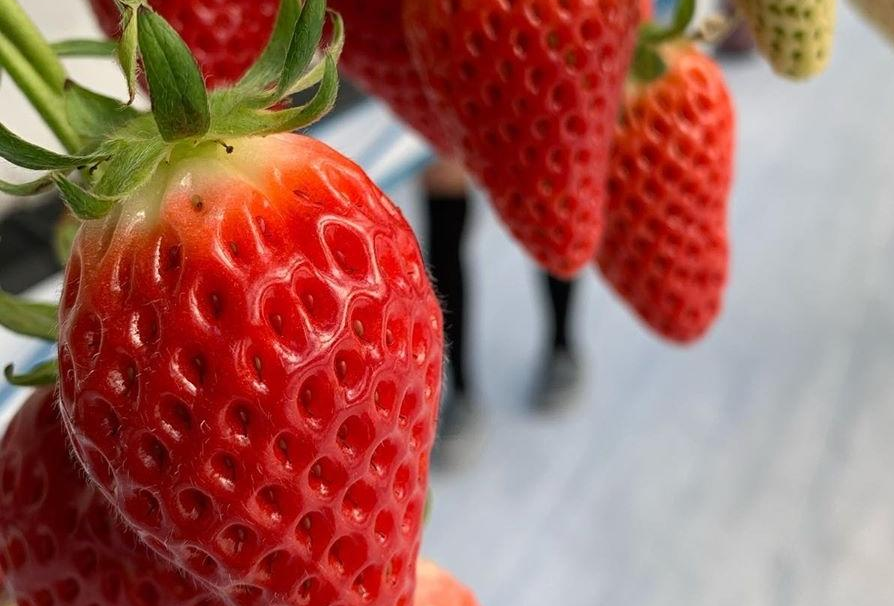
For decades, strawberry cultivation in Uruguay has been heavily reliant on soil. In fact, until very recently, over 95% of national production was carried out using traditional methods, with all the limitations that entails: disease problems, high dependence on manual labor, inconsistent yields, and significant strain on water and input resources.
Hydroponics was virtually nonexistent in the country, and when it was used, it typically relied on rudimentary gutters and improvised substrates—mixtures of sand and rice hulls—without any real control over drainage or root health. The result was predictable: unstable systems, low uniformity, and little confidence among growers.
A turning point: the first professional hydroponic project
The real change came in 2021, when a local producer invested in a professional raised hydroponic system, featuring high-quality gutters and a design built to last. That first installation, with 15,000 plants, marked a turning point in the perception of soilless cultivation in Uruguay.
It wasn’t just about producing differently, but about demonstrating with real data that well-designed hydroponics works better, even under local climatic conditions. Unlike other imported systems—such as NFT-type structures that didn’t adapt to the Uruguayan climate—the cultivation took place in macro-tunnel greenhouses, a much more stable and efficient solution for the region.
Five years later, the results speak for themselves.
Sustained growth, more plants and more production

Today, that initial project has given rise to a network of producers with over 16,000 m² of hydroponic cultivation, approximately 160,000 strawberry plants in production, and clear projections of exceeding 200,000 plants next year.
This growth is not a passing fad, but rather a reflection of a very specific economic and production reality:
- Higher yield per plant, thanks to a healthy and stable root system.
- Increased marketable volume, with more uniform and higher-quality fruit.
- Longer post-harvest life, key for supplying large retailers and direct sales.
- Improved fruit appearance, with less handling during and after harvest.
In some cases, producers have achieved selling prices of up to €6/kg, something unthinkable with traditional field systems.
The key technical element: healthy roots, total control, and real savings
The qualitative leap is explained by one essential factor: control of the root environment. Hydroponic Systems, with their durable, elevated channels and solutions that prevent the substrate from coming into contact with problematic surfaces, eliminate water accumulation and pathogen breeding grounds, ensure clean and continuous drainage, allow for the reuse of drainage water in other crops (reducing water consumption), and optimize fertilizer use by applying them more precisely and efficiently.
The result is lower production costs, accompanied by significant savings in water, fertilizers, and plant protection products, as well as a clear reduction in environmental impact.
Beyond the product: support that builds trust
Another crucial aspect of this success story has been the project’s comprehensive approach. The producers haven’t just invested in a cultivation system, but in a solution backed by real-world knowledge, based on direct experience as farmers.
This support includes the system’s design and installation, ongoing technical advice at no extra cost, and assistance in preparing investment projects to access bank financing. This close collaboration generates something key to any agricultural investment: certainty. The producers see that the system works, that others have already improved their results, and that the return on investment is achieved sooner than expected.
A key alliance for Uruguayan farmers
It is worth noting that one of the main drivers and pioneers of this transformation in hydroponic strawberry cultivation in Uruguay has been Aguas Uruguay, a family-owned company of producers that, in partnership with Hydroponic Systems, has spearheaded the implementation of professional hydroponic systems in the country. With over 12 years of experience in the sector, Aguas Uruguay has developed a comprehensive approach that encompasses the design, planning, installation, and commissioning of projects, along with ongoing management and agronomic support. This combination of high-quality technology, technical expertise, and local production experience has enabled them to offer efficient, reliable solutions tailored to Uruguay’s specific growing conditions, contributing steadily to the modernization and competitiveness of the national fruit and vegetable sector.
The future of strawberries in Uruguay is no longer in the soil
Today, even many farmers who were skeptical of hydroponics recognize that open-field cultivation is no longer viable in terms of profitability, health, and efficiency. Labor shortages, low productivity, and increasing market demands have accelerated this shift in mindset.
Professional hydroponics is no longer an alternative: it’s a strategic tool for producing more, better, and with fewer resources.
This real-world case in Uruguay demonstrates that investing in high-quality systems makes all the difference. Not all growing channels are created equal. Not all hydroponic solutions offer the same results. When design, materials, and expertise are aligned, the impact on yield and savings is measurable.
And, as more and more producers are discovering, it’s also unstoppable.