Growing tomatoes hydroponically in a greenhouse requires coordinating irrigation, nutrition, climate, root zone, and infrastructure as parts of a single system. Success depends not only on growing without soil but also on keeping these variables under control throughout the different phases of the cycle.
Proper management allows for reduced differences between plants and sections, anticipation of potential imbalances, and more uniform conditions for crop development.
At Hydroponic Systems, we have years of experience developing solutions for professional substrate-based cultivation. In this guide, we explain which aspects should be reviewed to manage hydroponic tomatoes more stably and predictably.
In this article, you will discover:
- Which variables must be coordinated throughout the cycle.
- How irrigation, fertigation, and root zone influence the crop.
- What role climate and infrastructure play.
- How to detect imbalances before they affect the crop.
What does managing a hydroponic tomato crop require?
Managing a hydroponic tomato crop requires observing the system as a whole. Irrigation scheduling affects substrate moisture; the nutrient solution influences the plant’s equilibrium; the climate modifies water demand; and the condition of the root zone determines its capacity to absorb water and nutrients.
Therefore, decisions should not be made in isolation. It is necessary to interpret the plant’s behavior, the environmental conditions, and the records of the growing system together.
Why system control is important
Hydroponic cultivation allows for more precise adjustment of water and nutrient supply and adapts management to the needs of each stage. However, this control only produces consistent results when irrigation, climate, substrate, and root zone are managed in a coordinated manner.
To learn about the differences compared to other production methods, see the advantages of hydroponic tomato cultivation.
What variables really influence production
The productivity of a hydroponic tomato crop is the result of the interaction between different factors. Analyzing each one separately helps to understand its function, but it is the way they work together that determines the crop’s performance.
Among the most relevant variables are:
- Water quality and nutrient solution management.
- Irrigation scheduling and application uniformity.
- Root zone development and oxygenation.
- The plant’s vegetative-reproductive balance.
- Planting density and crop distribution.
- Climate control within the greenhouse.
- The design of the cultivation system and its capacity to facilitate daily management.
When these variables are kept within appropriate ranges, the plant makes better use of water and nutrients, reduces physiological stress, and develops more uniform growth. This facilitates decision-making during the growing cycle and contributes to maintaining stable production.
How to assess crop stability
Crop stability can be assessed by observing plant uniformity, regular growth, commercial fruit quality, and differences between rows or sections of the greenhouse.
A general average can mask areas with excess water, reduced root development, or variations in nutrient solution application. Therefore, it is advisable to compare representative plants, examine the ends of rows, and record crop development under equivalent conditions.
When the objective is to specifically analyze yield per unit area, density, or kilograms harvested, consult our guide on how to increase tomato yield in a greenhouse.
How to optimize hydroponic tomato cultivation through efficient agronomic management
Once the factors influencing productivity are understood, the next step is to manage the crop as a system in which roots, water, nutrition, climate, and infrastructure work in a coordinated manner. The greater the control over these variables, the easier it will be to maintain stable production, reduce problems, and maximize the tomato’s productive potential.
Root zone, fertigation and nutritional balance
The root zone is where the plant absorbs the water and nutrients it needs to develop. Its condition directly influences crop vigor, fruit set, and the ability to maintain consistent production throughout the growing cycle.
To promote balanced root development, proper fertigation management is essential. This involves adapting the composition of the nutrient solution, controlling parameters such as pH and electrical conductivity (EC), and adjusting the irrigation schedule to the crop’s actual needs. A well-planned strategy prevents both excess and insufficient water, improves nutrient absorption, and reduces physiological stress.
The interpretation of these parameters should be complemented by observation of the substrate, drainage behavior, and differences between plants. A correct EC in the incoming solution does not, by itself, guarantee that all roots are receiving the same conditions.
Preventing imbalances through management
Irrigation irregularities, moisture accumulation, poor substrate aeration, or unbalanced vegetative development can increase crop vulnerability. Prevention, therefore, begins with regular monitoring of environmental conditions and the root zone.
This agronomic monitoring does not replace plant health measures or Integrated Pest Management, but it helps detect stressful situations before they develop into more serious problems.
How infrastructure influences daily operations
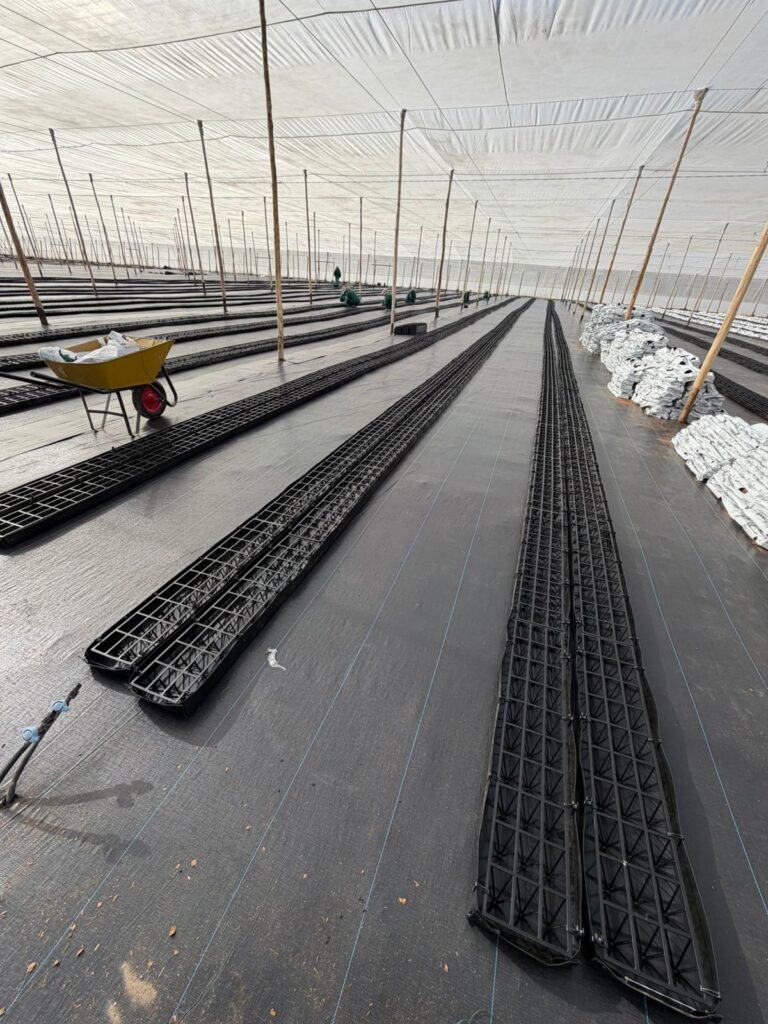
The infrastructure must facilitate the uniform application of irrigation, drainage, crop inspection, and access during pruning, staking, and harvesting.
A proper design does not replace agronomic management, but it helps ensure that decisions can be applied more consistently across all rows. It also facilitates the detection of differences between sections and reduces interference during daily work.
When drainage accumulates under the bags or roots come into contact with damp areas, it may be necessary to review the physical configuration of the system. See how channels and spacers work for hydroponic tomatoes.
What to check to maintain a stable crop
Optimizing a hydroponic system isn’t about acting on a single variable, but rather about identifying which decisions have the greatest impact on the entire system. Prioritizing those that improve crop control allows for increased efficiency, reduced variability, and more stable production over time.
| Observed sign | Variable to check | Initial action |
|---|---|---|
| Differences between rows | Irrigation uniformity | Check pressure, flow rate and drippers |
| Substrate too wet | Irrigation scheduling | Check frequency and duration |
| Uneven development | Climate, irrigation and nutrition | Compare sectors and records |
| Poorly aerated roots | Substrate and drainage | Check drainage discharge and accumulation points |
| Irregular production | Overall crop balance | Analyze trends, not isolated data |
Infrastructure and operational efficiency
The infrastructure significantly influences daily operations within the greenhouse. A system designed to facilitate irrigation, drainage, and access to the crops simplifies management tasks and helps maintain more uniform conditions for all plants.
It also influences aspects such as ergonomics during pruning, staking, and harvesting, as well as the ability to monitor crop conditions and detect potential problems more quickly. When the infrastructure facilitates these tasks, it becomes easier to consistently apply agronomic management strategies and reduce variability across different areas of the farm.
Crop consistency versus isolated results
Obtaining a large harvest at a specific time does not guarantee the success of an entire season. More and more farms are prioritizing stable production, since consistent yields facilitate planning, improve the commercial quality of the fruit, and allow for a more reliable response to market demands.
This stability depends on keeping variables such as fertigation, climate, root zone, and plant health under control. When the system functions in a balanced way, the crop responds more regularly, and the risk of losses associated with physiological stress or imbalances in plant development is reduced.
How to further improve crop management
Continuous improvement is an integral part of managing any professional hydroponic operation. Regularly reviewing system performance allows for the identification of opportunities to optimize management, adjust fertigation, improve irrigation uniformity, or reinforce preventative strategies before problems arise.
Adopting this holistic approach facilitates data-driven decision-making and a deeper understanding of how infrastructure, agronomic management, and environmental control interact. In this way, each improvement contributes to building a more efficient, stable production system, better equipped to meet the challenges of protected agriculture.
Continue optimizing your hydroponic tomato cultivation
Continuous improvement requires regularly reviewing irrigation scheduling, row uniformity, root zone behavior, and the crop’s response to climate change.
The goal is not to act on a single variable, but to understand how water, nutrition, climate, substrate, and infrastructure interact. This perspective allows for more informed decision-making and the maintenance of more stable conditions throughout the growing cycle.
To learn about the solutions available for professional greenhouse tomato projects, consult our hydroponic tomato systems or contact our technical team.