Hydroponic Strawberry Systems for Commercial Greenhouses
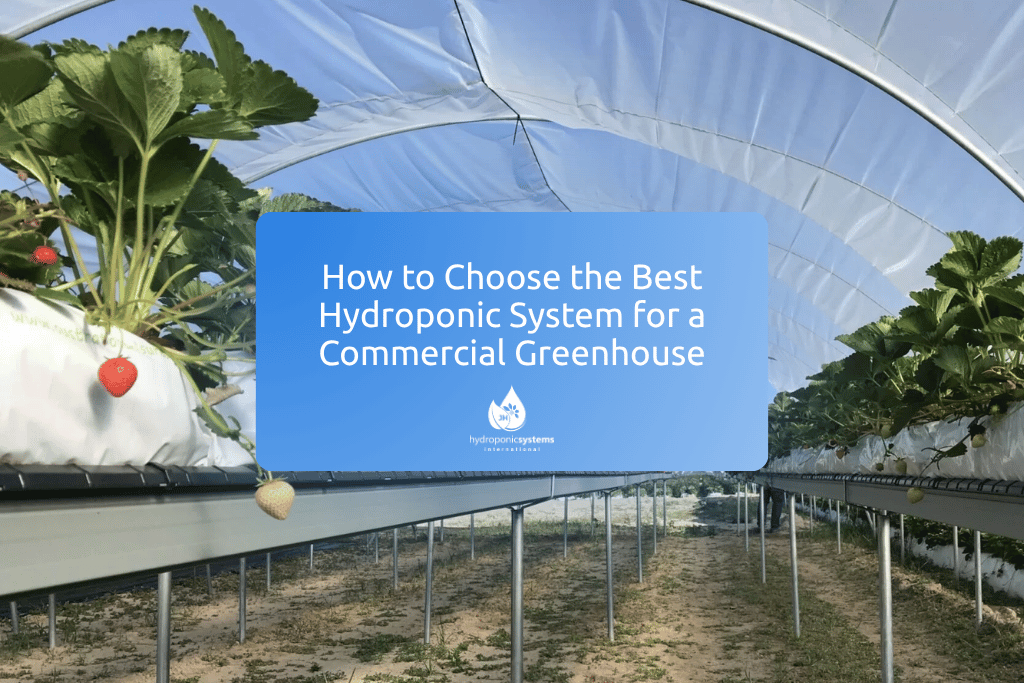
Hydroponic Systems manufactures soil-level, elevated and hanging gutter solutions for professional strawberry production. Each system is configured according to the greenhouse structure, crop density, substrate, drainage requirements, working height and production objectives of the project.
Our solutions help growers create a cleaner and more controlled root environment, improve access to the crop and manage drainage efficiently across new greenhouse developments and conversions from soil cultivation.
Tell us your country, greenhouse area and preferred cultivation system. Our technical team will assess the most suitable configuration for your project.
Strawberry growing systems designed around the project
Commercial strawberry production requires a system that responds to the real conditions of the greenhouse. Crop density, working height, available structure, substrate format, irrigation strategy, drainage collection and labour organisation all influence the final configuration.
Hydroponic Systems develops gutter solutions for strawberry growers who want to establish a new soilless crop, modernise an existing greenhouse or replace a system that no longer provides sufficient drainage, stability or access to the plants.
The objective is to create a production layout that supports consistent crop management throughout the cycle and remains practical for irrigation, harvesting, crop inspection, cleaning and maintenance.
For commercial growers
Systems intended for professional strawberry production.
Project-specific configurations
Designed according to greenhouse dimensions, crop layout and production requirements.
Drainage management
Solutions that collect drainage water and help keep the root zone separated from accumulated runoff.
International supply
Project support for growers, greenhouse companies and agricultural distributors in different markets.
Compare hydroponic strawberry growing systems
There is no single configuration suitable for every strawberry project. The most appropriate system depends on the existing greenhouse, available investment, target plant density, labour model and the level of crop accessibility required.
Soil-level gutter systems
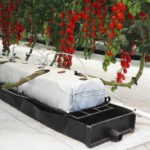
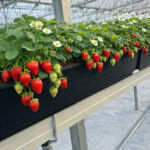
Soil-level gutter systems offer a practical route for moving strawberry production away from direct soil contact while maintaining a relatively simple crop layout.
The gutters support substrate bags or crop containers, collect drainage and create a defined cultivation line. This option can be suitable for growers converting existing tunnels or greenhouses where the current structure does not allow a suspended installation.
Suitable for:
Greenhouse conversions, substrate bags, straightforward installations and projects seeking controlled drainage with moderate structural requirements.



Elevated strawberry gutter systems
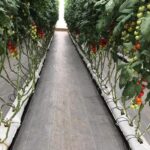
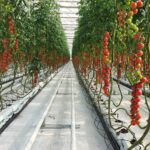
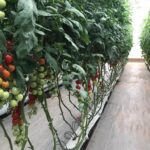
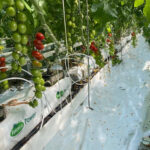
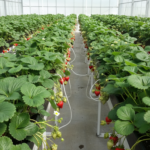
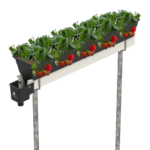
Elevated systems position the crop at a more accessible working height, making crop inspection, maintenance and harvesting easier. They also create a cleaner separation between the production line and the greenhouse floor.
The final height and support structure must be designed according to the greenhouse, aisle configuration, crop density and operational requirements of the farm.
Suitable for:
Professional strawberry farms focused on crop accessibility, organised drainage and improved working conditions.
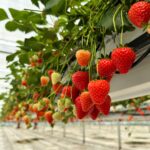
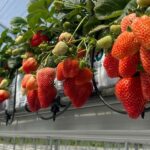
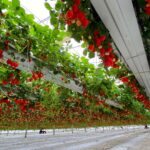


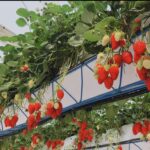

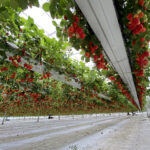
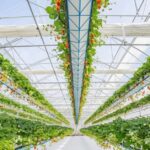
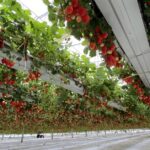
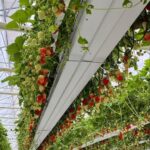
Hanging strawberry gutter systems
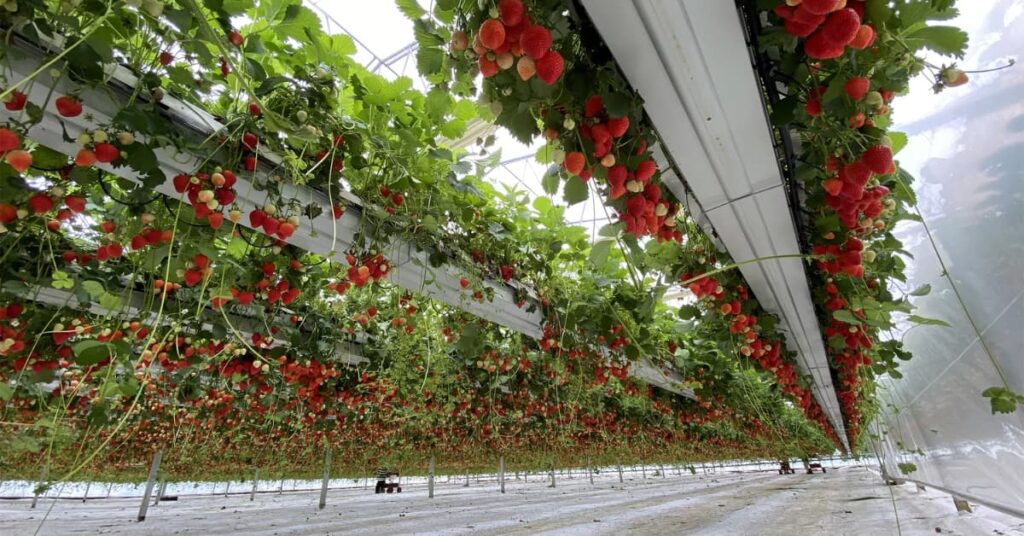
Hanging systems use the greenhouse structure to support the cultivation lines and can provide a high level of accessibility and floor clearance. They are especially relevant for technically advanced projects where greenhouse design, structural capacity, irrigation and cultivation layout are planned together.
Load distribution, suspension points, gutter spacing and working height must be evaluated during the design phase.
Suitable for:
New greenhouse projects, high-technology production and farms seeking a suspended cultivation layout.
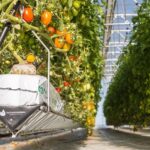
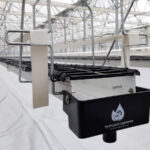
Individual pot and reusable substrate systems
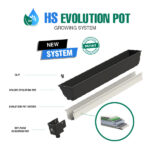
Individual pot systems provide a defined growing unit for each plant or group of plants. They can facilitate substrate management, replacement, cleaning and the reduction of disposable cultivation materials, depending on the selected configuration.
Hydroponic Systems can integrate these solutions with drainage gutters, supports and crop layouts developed for professional strawberry production.
Suitable for:
Growers seeking individual substrate control, reusable components and flexible crop management.
Which strawberry system is suitable for your greenhouse?
| System | Typical application | Crop accessibility | Drainage management | Structural requirement |
|---|---|---|---|---|
| Soil-level gutter | Conversion from soil or basic substrate projects | Standard | Controlled collection | Low to moderate |
| Elevated gutter | Professional production at an accessible working height | High | Controlled collection | Moderate |
| Hanging gutter | Technically advanced greenhouse production | High | Integrated into the crop line | High |
| Individual pot system | Flexible substrate and plant management | High | Individual or line-based | Depends on configuration |
This comparison provides an initial reference. Final system selection must consider greenhouse dimensions, structural capacity, wind and snow loads where applicable, cultivation density, plant spacing, irrigation layout, substrate weight, crop load and the equipment used by workers.
What should be evaluated before selecting a strawberry growing system?
Greenhouse structure
Existing tunnels and greenhouses may limit the possible working height, suspension points or total load. New projects provide greater freedom to integrate the crop system into the structural design.
Crop density and line spacing
Plant density affects the number of cultivation lines, gutter spacing, irrigation capacity, labour movement and the total number of linear metres required.
Substrate and container format
The gutter must be compatible with the width, height and weight of the selected substrate bag, slab or pot. Drainage outlets must remain clear and stable throughout the production cycle.
Working height and labour
Crop height influences harvesting speed, crop inspection, leaf removal, maintenance and worker posture. The correct height depends on the production method and the equipment used inside the greenhouse.
Drainage strategy
The project must define how drainage will be collected, transported, measured, treated or reused. Gutter slope, continuity and discharge points must be coordinated with the irrigation and water-management design.
Root-zone hygiene
The cultivation system should reduce prolonged contact between roots and accumulated drainage, allow regular inspection and facilitate cleaning between crop cycles.
Keep the root zone separated from drainage
Drainage management is one of the most important technical considerations in substrate-grown strawberries. When drainage accumulates beneath a bag or remains in contact with emerging roots, the root environment becomes more difficult to control.
Hydroponic Systems gutters are designed to collect runoff along the cultivation line. Spacer technology creates a physical separation between the substrate bag and the bottom of the gutter, helping drainage water move below the crop support area while allowing additional space around the base of the bag.
This configuration supports more orderly water collection, easier visual inspection and better management of the area surrounding the roots.
Defined drainage route
Runoff is collected and directed along the cultivation line.
Separation from accumulated water
The substrate bag remains raised above the gutter base.
Cleaner crop management
The system facilitates inspection, maintenance and cleaning between production cycles.
Designed for efficient commercial strawberry production
Better access to plants
Elevated and hanging layouts can improve access during harvesting, crop inspection, leaf removal, pest monitoring and maintenance.
Controlled drainage collection
A defined gutter line helps prevent uncontrolled runoff beneath the crop and facilitates the transport of drainage towards collection points.
Compatibility with substrate production
The systems can be configured for commonly used strawberry substrates, bags and pot formats, subject to project requirements.
Cleaner greenhouse organisation
Separating the production line from the floor creates a clearer distinction between crop, drainage and working areas.
Adaptation to new and existing projects
Systems can be considered for new greenhouse developments, existing structures and transitions from soil cultivation to substrate production.
Scalable project design
The required number of lines and linear metres can be calculated according to greenhouse dimensions, plant density and future expansion plans.
Commercial strawberry projects in different growing regions
Hydroponic Systems has supplied strawberry cultivation solutions for projects in Europe, Asia and the Americas. Each installation responds to different greenhouse structures, climates, production models and commercial objectives.
Japan: 12.5 kg of strawberries per square metre
A Japanese grower reported a production level of 12.5 kg per square metre using a lifting cultivation system supplied by Hydroponic Systems.
The project combined accessible crop positioning with a configuration developed for professional greenhouse production.
Northern Europe: 1.5 kg per plant
A strawberry grower in Northern Europe reported production of 1.5 kg per plant using a hanging metal gutter system with Spacer.
The installation was designed around the greenhouse structure, crop layout and the need to maintain organised drainage below the substrate.
Mexico: strawberry production for export
Hydroponic Systems has supplied hanging gutter solutions for commercial strawberry projects in Mexico, including installations developed for export-oriented production.
These projects demonstrate how gutter design, Spacer integration and crop layout can be adapted to large professional growing areas.
Uruguay: transition from soil to hydroponic production
A strawberry project in Uruguay moved from conventional soil cultivation to a hydroponic production system developed to improve crop organisation, drainage management and productive capacity.
The case provides a practical reference for growers evaluating a transition from soil to substrate.
Production results vary according to variety, climate, greenhouse technology, crop density, irrigation management, nutrition, pest and disease control, labour and other agronomic factors. The figures presented correspond to specific customer projects and should not be interpreted as guaranteed results.
From project information to system configuration
1. Project assessment
We review the country, greenhouse dimensions, cultivated area, crop layout, substrate format, plant density and production objectives.
2. System selection
Our team evaluates whether a soil-level, elevated, hanging or individual pot configuration is the most suitable starting point.
3. Technical definition
Gutter model, supports, line spacing, working height, drainage direction and integration with Spacer are defined according to the project.
4. Manufacturing and logistics
The required components are manufactured and prepared for delivery according to the project schedule and destination.
5. Installation guidance and project support
Technical documentation and installation guidance are provided to support correct assembly and system operation.
What information do we need to prepare a proposal?
Providing the following information will help our technical and commercial teams evaluate the project more accurately:
- Country and project location.
- Total greenhouse area.
- New project or conversion of an existing crop.
- Type and dimensions of the greenhouse.
- Number of plants or target plant density.
- Substrate bag, slab or pot dimensions.
- Preferred working height.
- Soil-level, elevated or hanging system preference.
- Drainage collection requirements.
- Approximate project date.
Technical resources for hydroponic strawberry growers
Hydroponic strawberry farming guide
Learn about the main principles of commercial hydroponic strawberry production, including systems, substrates, irrigation, climate and crop management.
How to select the best system
Compare soil-level, elevated and hanging configurations according to greenhouse structure, crop accessibility and investment requirements.
Strawberry plant density
Review the main factors that determine plant density, line spacing and the number of cultivation rows inside a greenhouse.
Root and collar rot
Examine the conditions that favour root-zone problems and the role of drainage, hygiene and substrate separation.
Water savings and drainage
Understand how gutter and Spacer systems can support drainage collection and more controlled water management.

Frequently asked questions about hydroponic strawberry systems
What is the best hydroponic system for commercial strawberry production?
The most suitable system depends on the greenhouse structure, crop density, available working height, substrate, labour organisation, drainage strategy and budget. Soil-level systems can be appropriate for straightforward conversions, while elevated and hanging systems provide greater crop accessibility and floor clearance.
Can strawberries be grown in substrate bags?
Yes. Commercial strawberries are frequently grown in substrate bags, slabs or containers. The gutter dimensions and support system must be compatible with the selected substrate format and its saturated weight.
What is the difference between elevated and hanging strawberry gutters?
Elevated gutters are supported from the floor or by a dedicated support structure. Hanging gutters are suspended from the greenhouse structure. The choice depends on structural capacity, greenhouse design, target working height and project layout.
Can an existing greenhouse be converted to hydroponic strawberry production?
In many cases, an existing greenhouse can be converted. The structure, available height, aisle width, irrigation system, floor condition and load capacity should be assessed before selecting the cultivation system.
How does Spacer work in strawberry cultivation?
Spacer raises the substrate bag above the bottom of the gutter, creating separation between the bag and collected drainage. This helps prevent direct contact between emerging roots and accumulated runoff and facilitates visual inspection of the drainage area.
Can drainage water be collected for reuse?
Gutter systems can direct drainage towards designated collection points. Reuse depends on water quality, disinfection, nutrient management, local regulations and the technical design of the irrigation system.
How many metres of gutter are required per hectare?
The number of linear metres depends on greenhouse geometry, line spacing, aisle width, plant density and the cultivation layout. A project calculation is required to provide an accurate figure.
Does Hydroponic Systems supply international projects?
Hydroponic Systems works with commercial growers, greenhouse companies and agricultural distributors in international markets. Delivery conditions and project support are evaluated according to the destination and scope of supply.
Can the system be adapted to different strawberry varieties?
The physical system can be configured for different production strategies, although plant spacing, substrate volume, irrigation and crop management must be defined according to the variety, climate and production cycle.
How can I request a quotation?
Send us the project country, greenhouse area, crop density, substrate format, preferred system and estimated installation date. Our team will review the information and contact you to discuss the appropriate configuration.
Share the basic details of your greenhouse, cultivated area and production objectives. Our technical and commercial teams will help you compare the available configurations and define a system adapted to your project.
Request a Hydroponic Strawberry System Proposal
Complete the form with the basic details of your project. The information will allow our team to prepare a more relevant initial assessment.